 MagyarGo
Everything you can doin MagyarGo
Lessons with exercises, books with audio, six guides, word review and statistics. Below, every part in detail, with screens of the web version.
- 200 lessons
- 75 books with audio
- 7,000 most frequent words
- 1,500 verbs
- 125 grammar articles
- 370 phrase topics
Lessons, exercises and words
What every day of study is made of: a rule, exercises on it, and words that later come back for review.
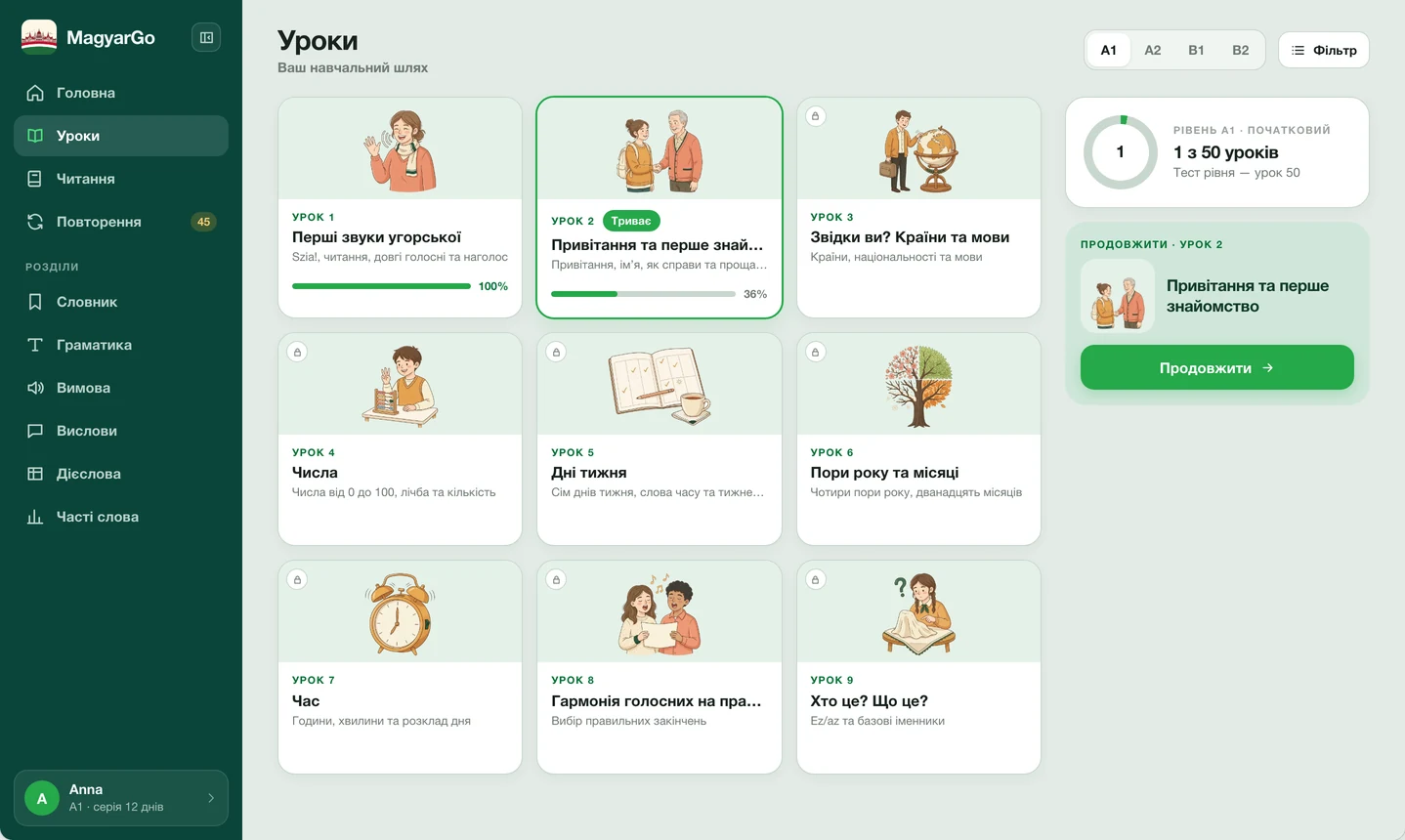
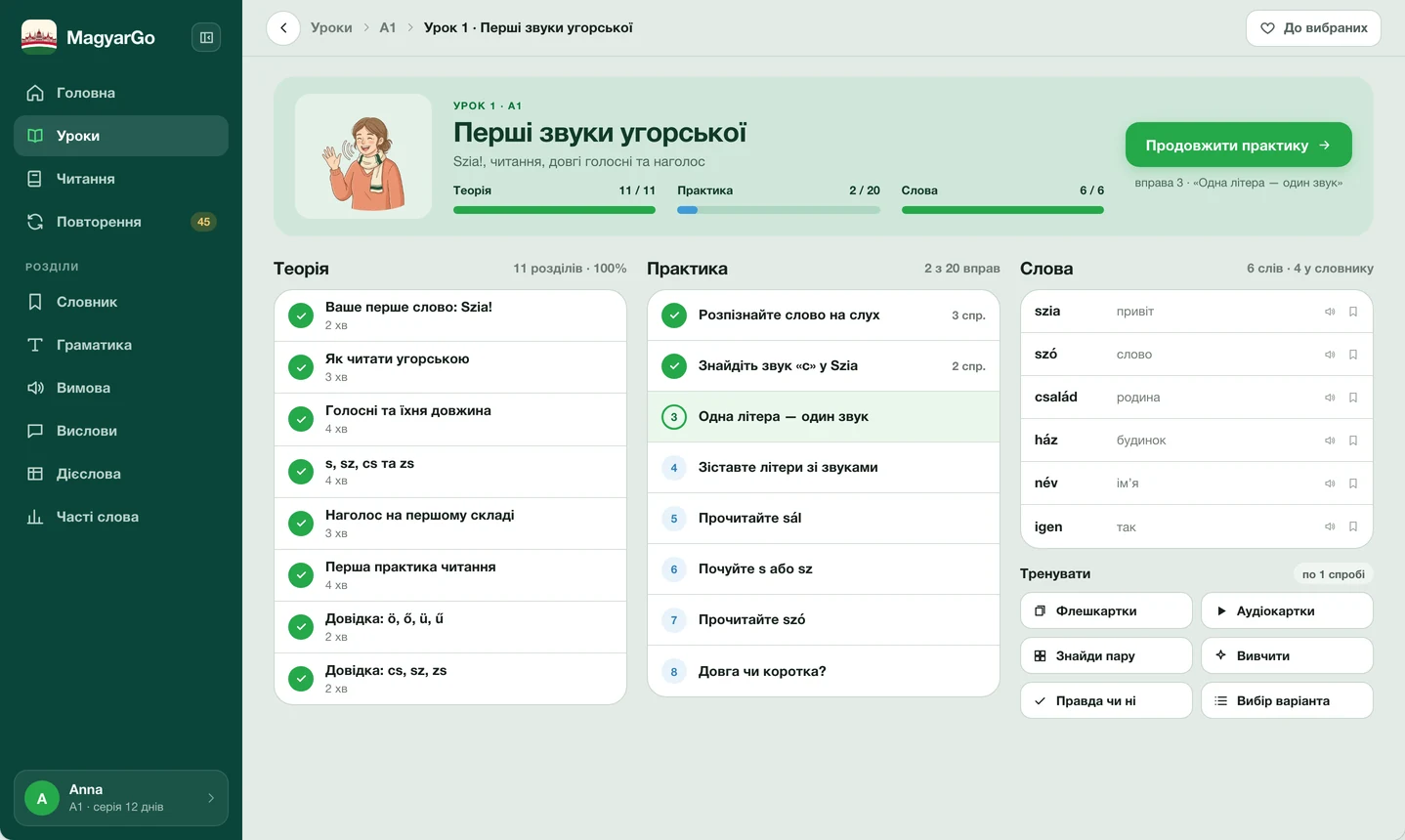
200 lessons from your first word to B2
Four levels — A1, A2, B1 and B2 — with 50 lessons each. Every lesson builds only on what you have already learned.
- Each lesson has three parts: theory, practice and words. At a computer you see all three side by side.
- Every level ends with a review lesson and a final test.
- The cover, the title and a progress bar show where you stopped.
- You can add a lesson to your favourites; they are collected in your profile.
- At the start MagyarGo asks about your goal, your level and your minutes a day, and makes a plan: which lesson to begin with and roughly how many months the level will take.
- A1 · 50 lessons
- A2 · 50 lessons
- B1 · 50 lessons
- B2 · 50 lessons
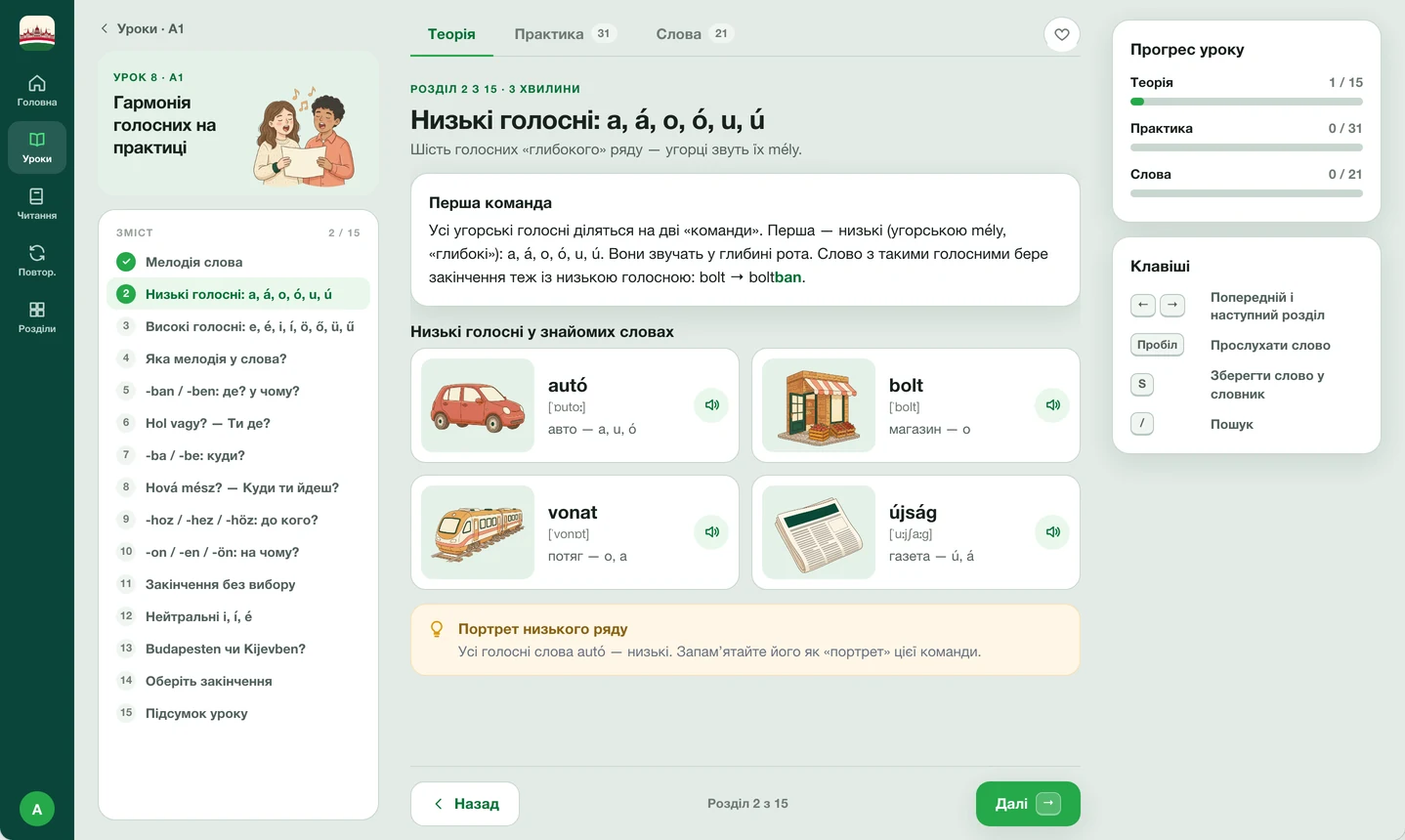
A rule, examples and a check right away
Explained in English: a short formula, real examples and questions that show whether everything is clear.
- Words come as cards: a picture, a transcription, a translation and a recording.
- Examples and dialogues can be played: levels A1 and A2 are fully recorded, B1 and B2 are being added.
- Self-check questions stand right in the text — answer and read on.
- Tables, tips, notes on culture and a short summary at the end of the lesson.
- At a computer the lesson contents are on the left, your progress on the right and the text in the middle.
- word cards
- tables
- dialogues
- tips
- self-check
- culture
- summary
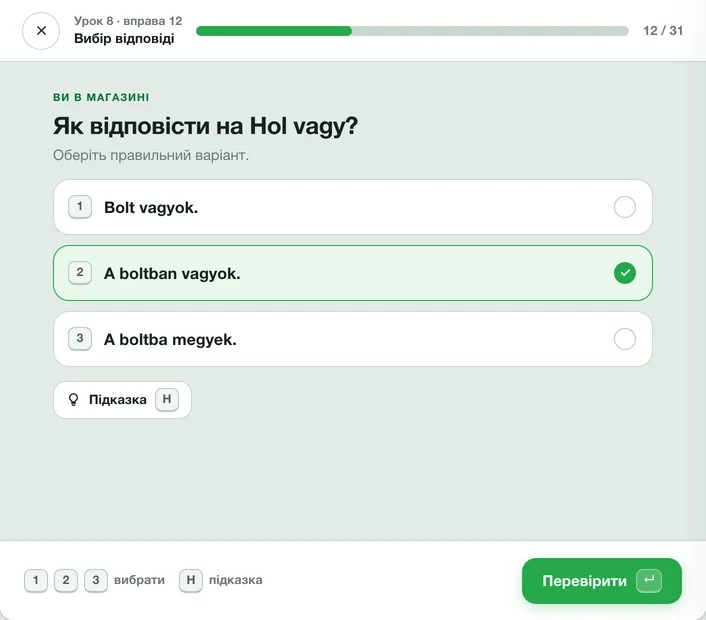
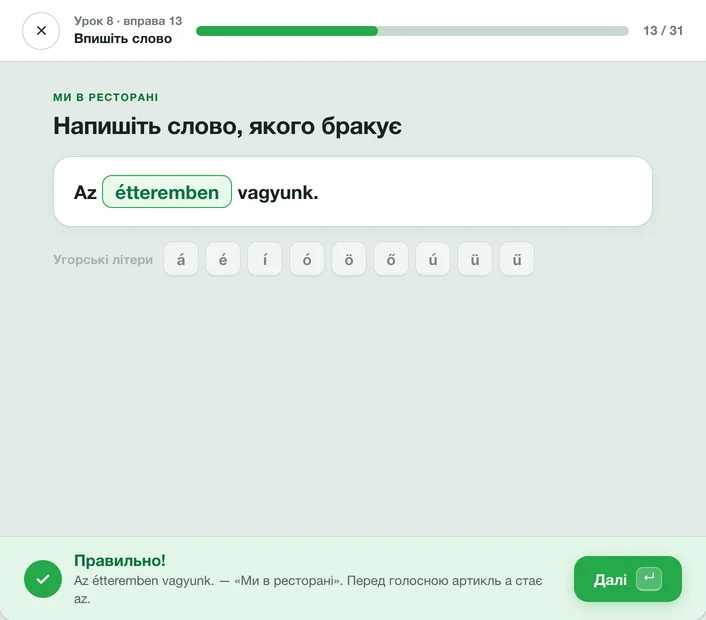
13 types of exercises, with an explanation after the answer
One rule from several angles: choose, fill in, build, translate, listen. After your answer MagyarGo says why it is so.
- Got it wrong? Try again or skip it; when you are stuck, there is a hint.
- In word-order exercises every correct order counts, not just one.
- At the end you get a result and a “Repeat the mistakes” button: you redo only what went wrong.
- 100% earns fireworks; 90% and more, confetti.
- In the browser it all works from the keyboard: digits pick an answer, Enter checks it.
- multiple choice
- fill in the gap
- word order
- pairs
- translation
- dialogue with gaps
- questions on a text
- pick by picture
- word meaning
- cards
- text by ear
- choice by ear
- sentence by ear
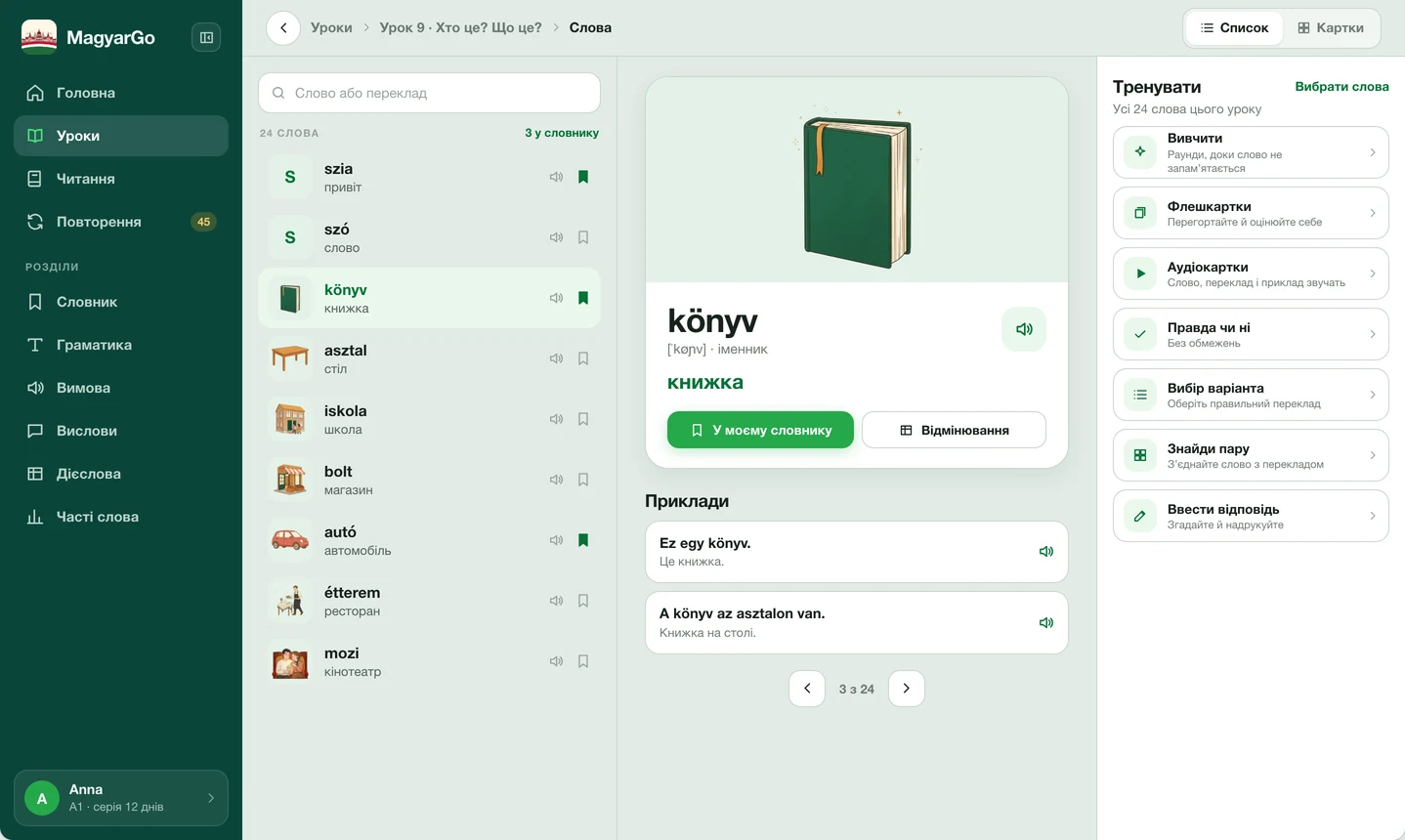
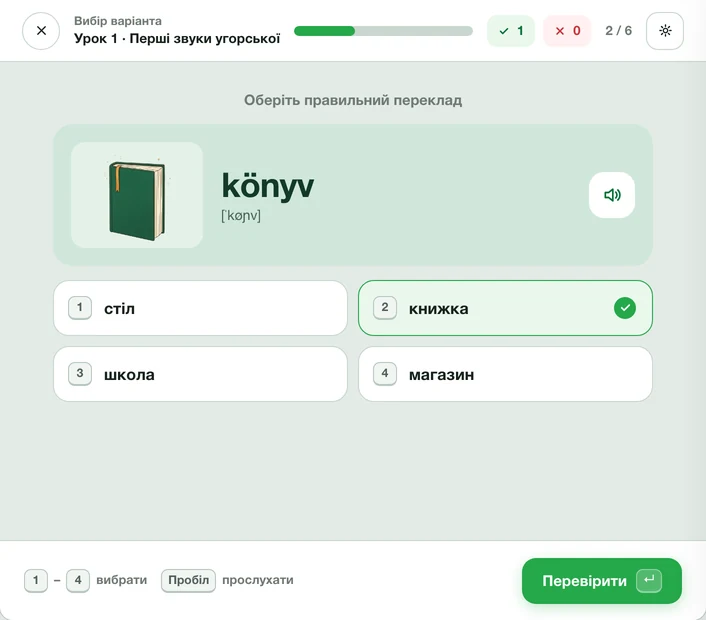
11 ways to learn a word
Every lesson word has a picture, a transcription, a recording and an example. Then choose the drill that suits your mood.
- A full word card: examples, and for verbs and nouns a link to all their forms.
- Drill all the words of a lesson or only the ones you marked yourself.
- Settings: random order, repeating a word after a mistake, direction “Hungarian → English” or the other way round.
- After a drill MagyarGo suggests the next one: harder if all went well, or a different one to make it stick.
- At a computer the list, the card and the drills share one screen.
- Flashcards
- Learn
- True or false
- Multiple choice
- Type the answer
- Match
- Spell it out
- Listen and pick
- Dictation
- Audio cards
- Guess from the picture
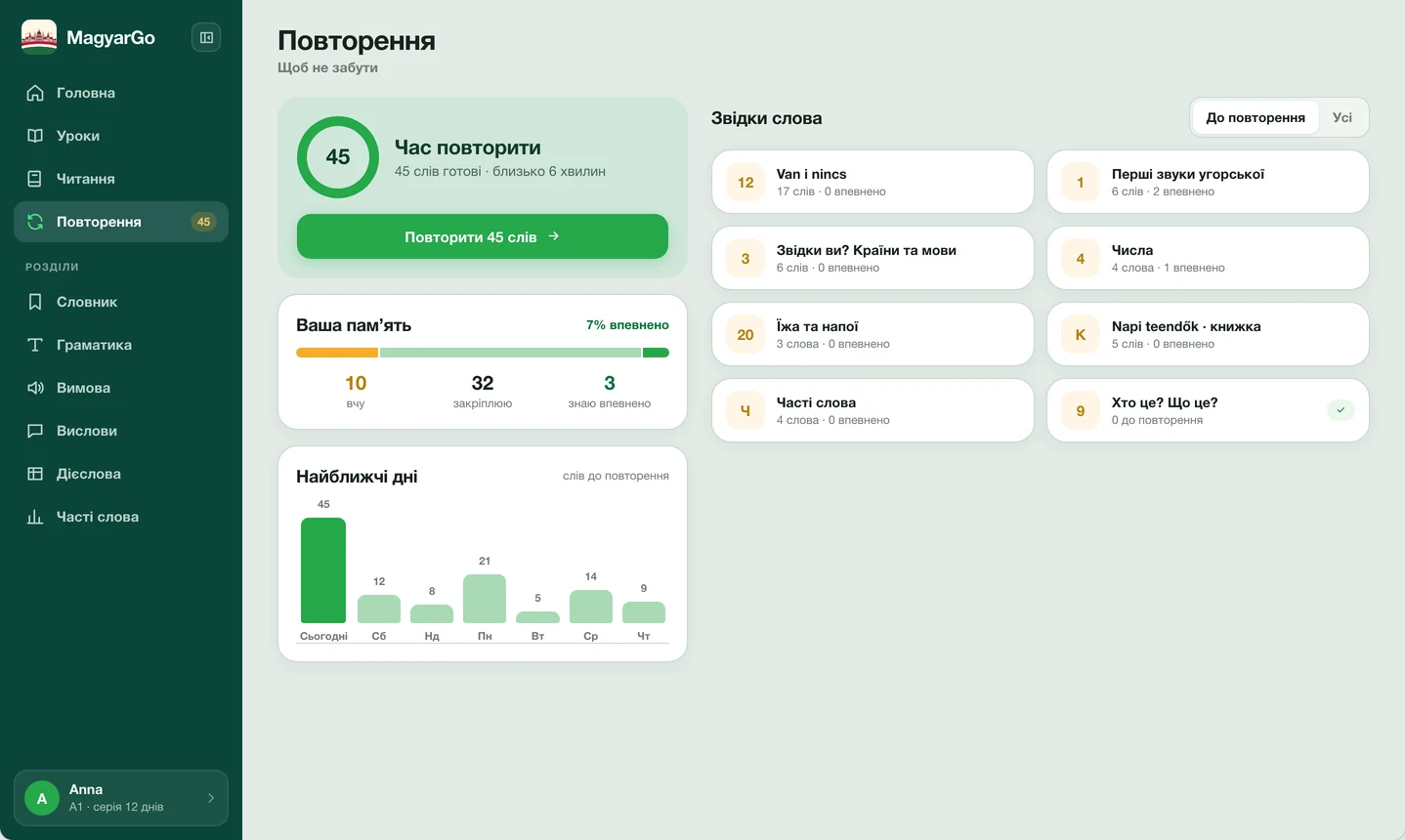
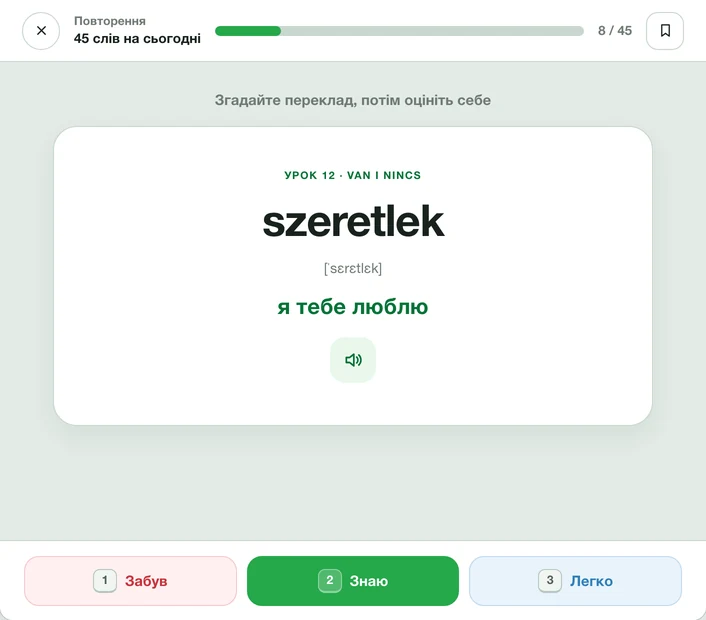
Words come back just when you start to forget them
Answer a word correctly in a drill and it goes to Review, returning in a day, in three days, in a week and so on.
- Three answers: “Forgot”, “I know it”, “Easy”. They decide when the word appears again.
- A forgotten word is back in ten minutes; a well-known one only after months.
- The better you know a word, the harder the card: first recall it, then choose it, then type it.
- “Your memory” shows how many words you are still learning, how many you are strengthening and how many you know for sure.
- At a computer you also see “The days ahead”: how many words will be waiting tomorrow and through the week.
- Forgot
- I know it
- Easy
Books you can listen to
Real texts at your level, with a recording, a translation and a dictionary at hand.
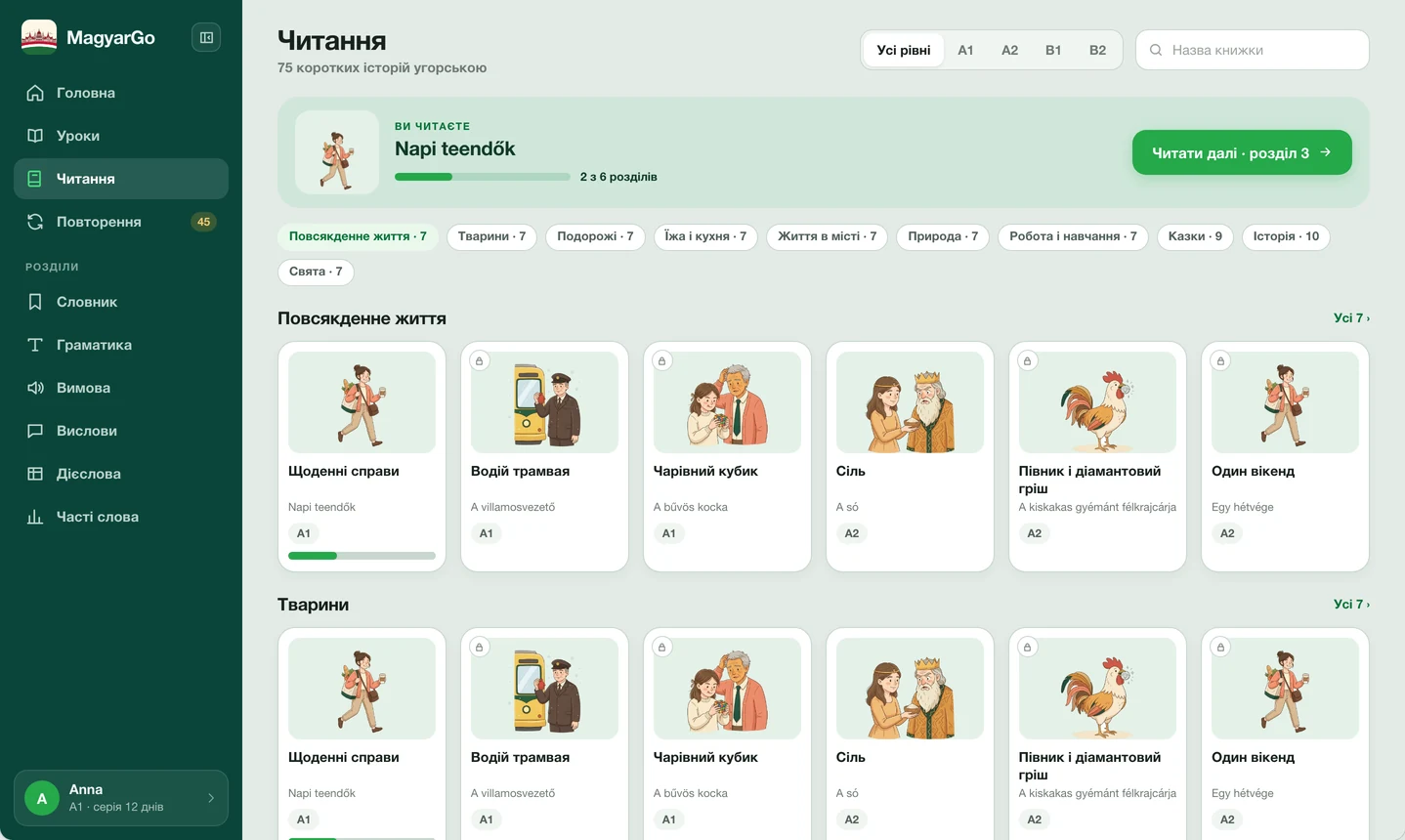
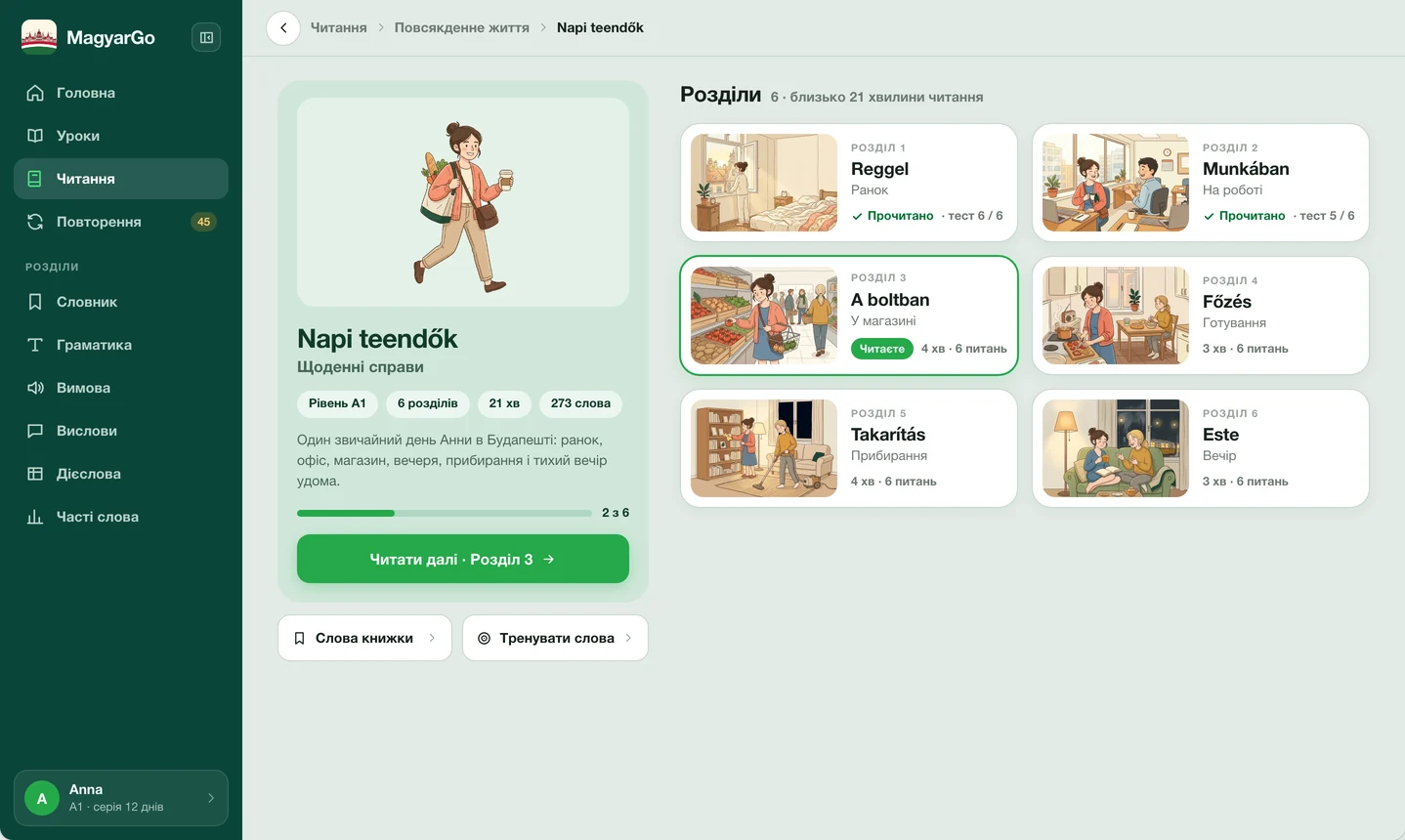
75 books from A1 to B2
Folk tales, history, everyday life, work, travel. Each book is a few short chapters with illustrations.
- Ten shelves by topic; every book shows its level, number of chapters and reading time.
- “You are reading” takes you back to the chapter where you stopped.
- Every chapter has its own illustration — more than four hundred in all.
- In the browser there is a level filter and a search by title.
- Everyday life
- Animals
- Travel
- Food and cooking
- City life
- Nature
- Work and study
- Folk tales
- History
- Holidays
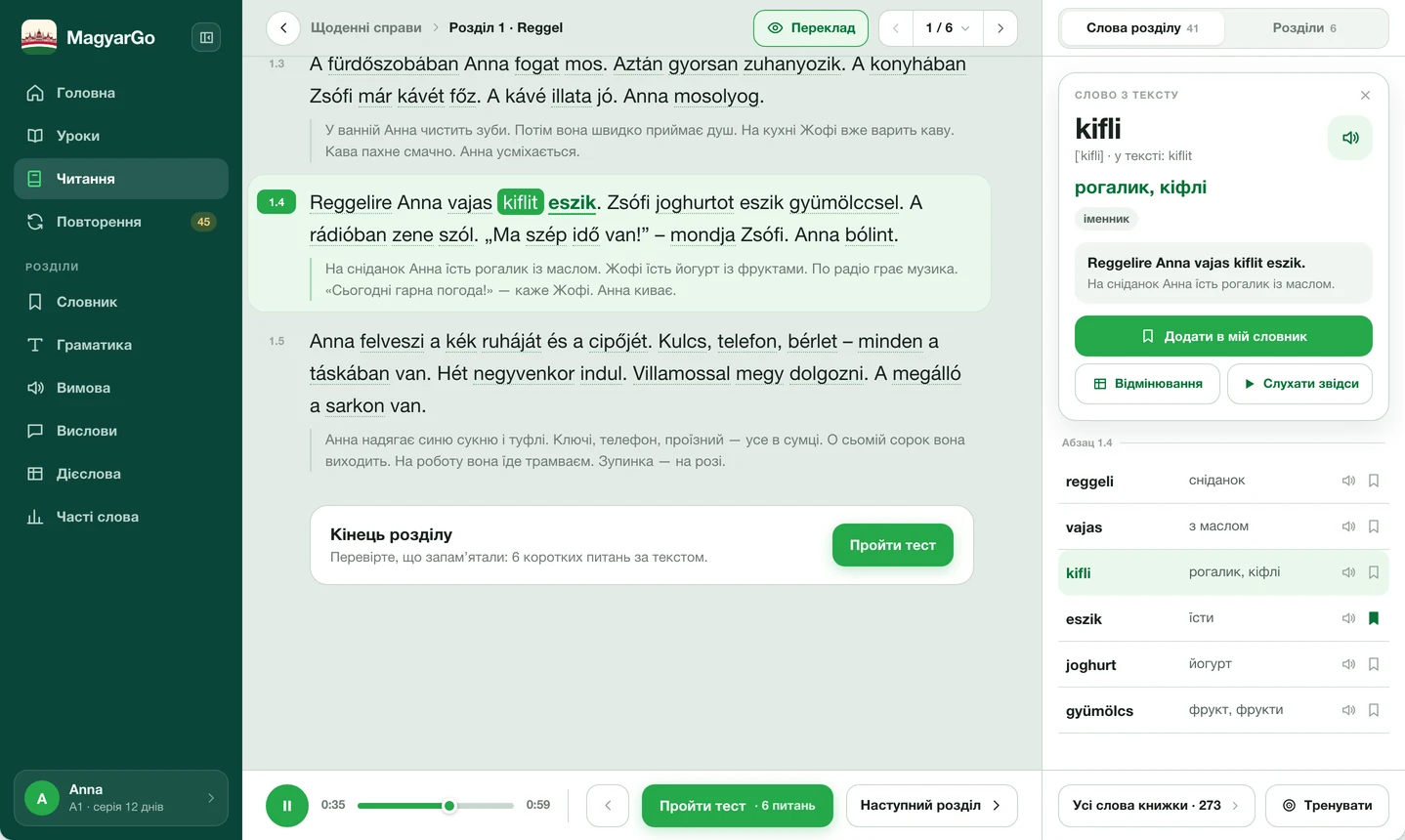
Read, listen and understand every word
Start the recording: the word being spoken is highlighted and the text scrolls along by itself.
- Select a word to see its translation, its part of speech and an example from the book; the bookmark saves it to “My dictionary”.
- Listen from any word or paragraph, not only from the beginning.
- Paragraph translations turn on with one button, and off again.
- After a chapter there is a short quiz with the answers explained.
- Every book has its own glossary, and its words can be practised with the same drills.
- At a computer the chapter words sit in a panel beside the text.
- chapter recording
- translation
- book glossary
- quiz after a chapter
Everything you need to find fast
What the lessons unfold step by step is gathered here by topic: open, find, practise.
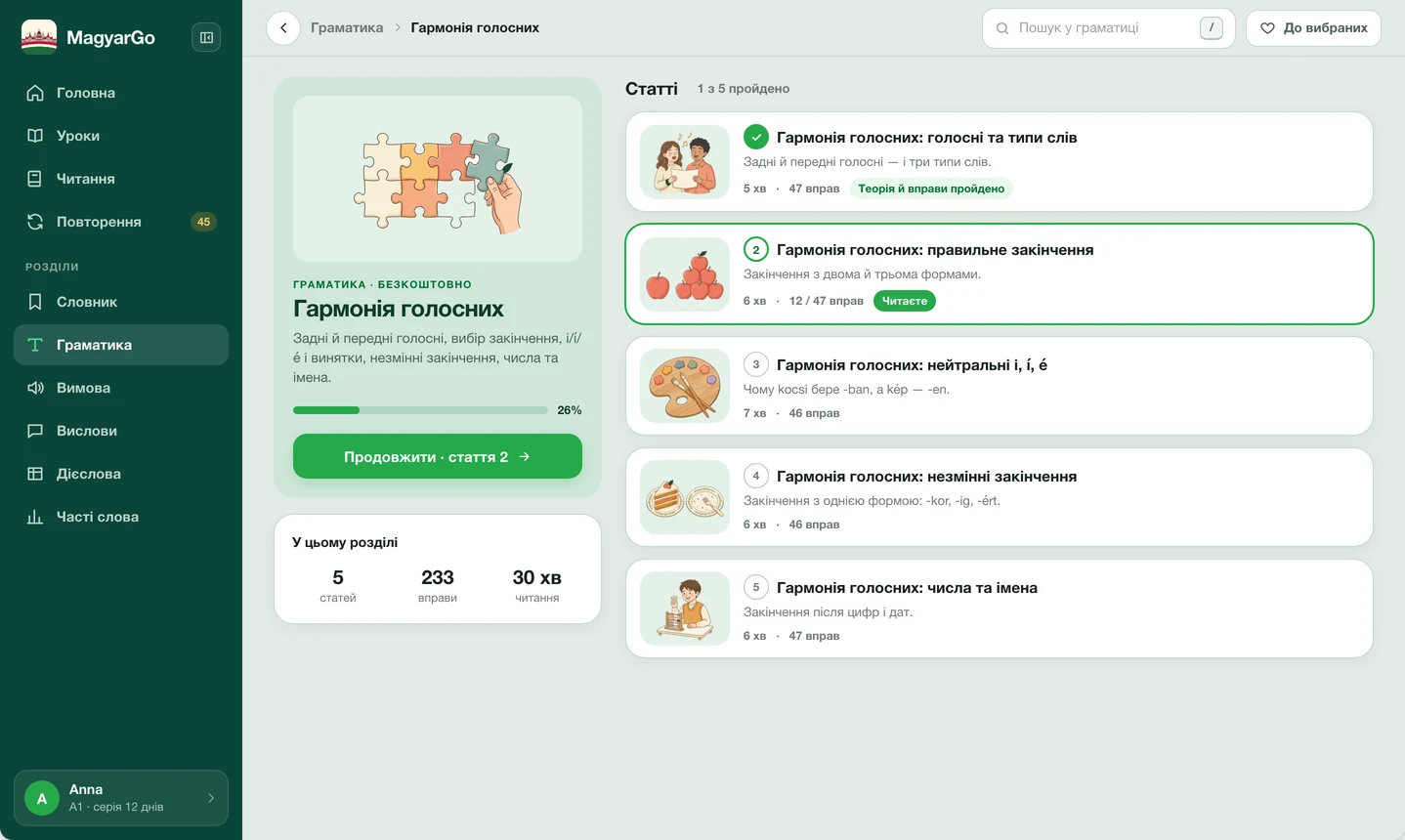
125 articles and more than 5,000 exercises
All of grammar by topic, from vowel harmony to the conditional. Every article has two tabs: “Theory” and “Exercises”.
- The theory is written in Hungarian, as in a textbook; the translation turns on with one button.
- Each article has several dozen exercises, so the topic really sticks.
- Marks show where the theory is read and where everything is done.
- Articles can be added to your favourites and paged through one after another.
- Theory
- Exercises
- one-click translation
- favourites
31 articles on sounds, stress and melody
How to read Hungarian letters, how long vowels differ from short ones and how sounds change next to each other.
- A transcription for every example — the same one the lesson words use.
- The articles come with exercises: more than 900 in all.
- The same two tabs as in grammar: “Theory” and “Exercises”.
- sounds
- length
- stress
- transcription
370 topics with ready-made phrases
The doctor, the bank, renting, work, paperwork, the citizenship interview. Each topic gives the phrases people really say and the answers you will hear.
- Phrases come as cards with a transcription and a recording; any of them can be saved to “My dictionary”.
- Search the phrases: type a word and find a ready-made expression.
- Topics are grouped by situation, and each one shows its level.
- Citizenship · 46
- Documents and offices · 20
- Work · 15
- Health · 11
- Housing · 11
- Transport and cars · 11
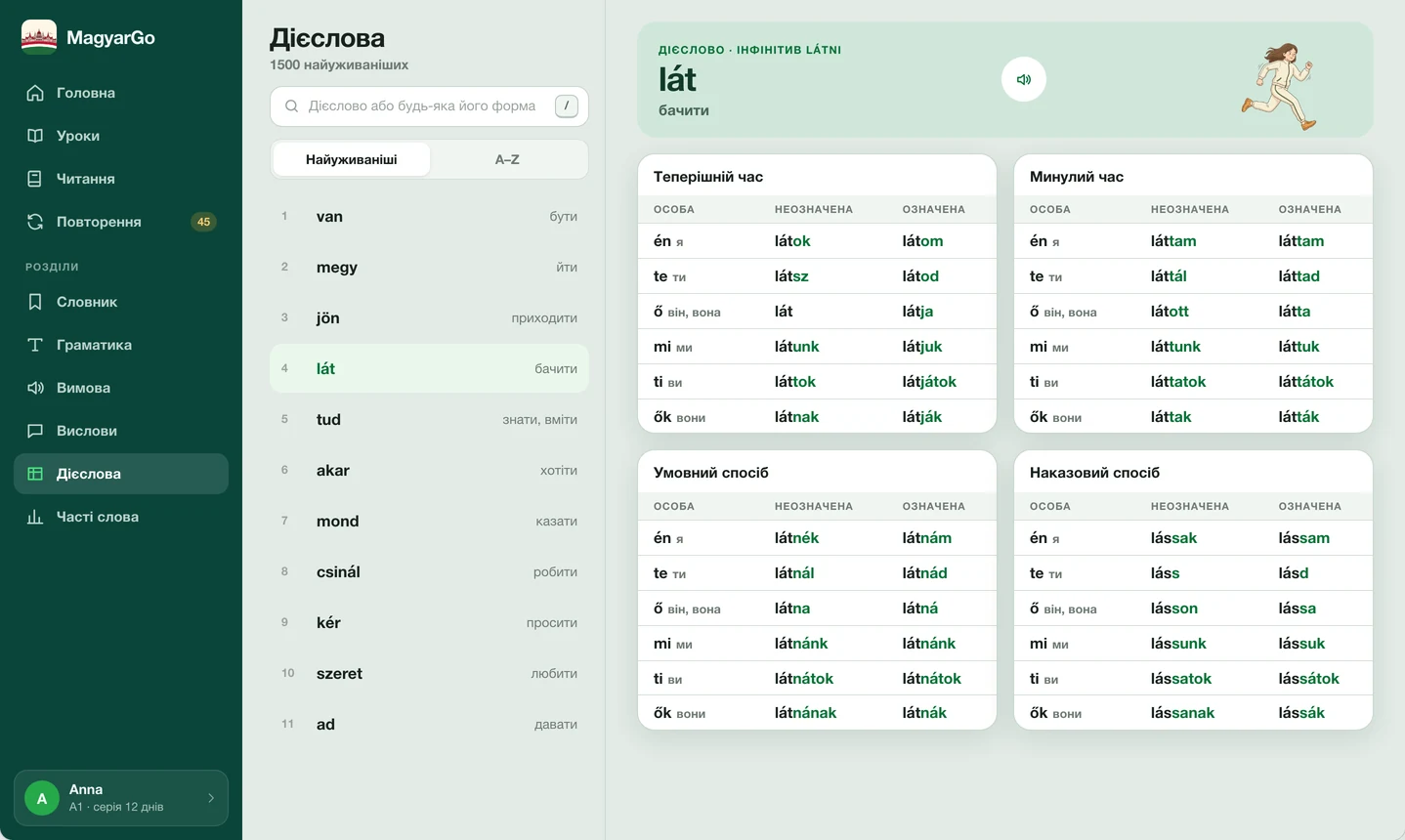
1,500 verbs — every form on one screen
Find a verb and see four tables at once: present and past tense, conditional and imperative.
- Each table has both conjugations — indefinite and definite — and the “I → you” form.
- Search by the verb itself, its translation or any form: type “láttam” and you find “lát”.
- Sort by frequency or alphabetically.
- For verbs with prefixes the whole family is shown.
- Present
- Past
- Conditional
- Imperative
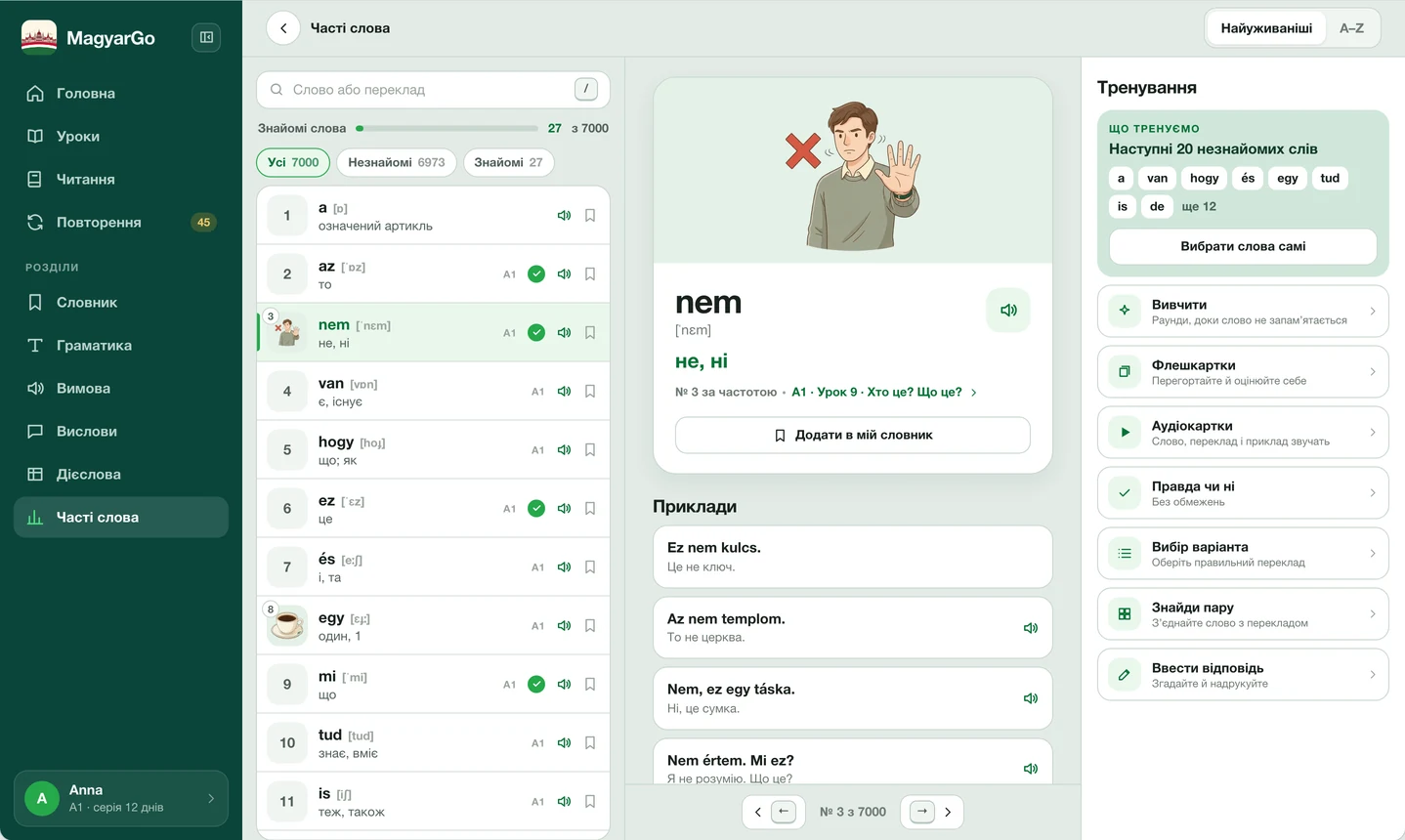
7,000 words by how often they are used
The words you meet most often, from “a” and “nem” onwards. You learn what you will need first.
- Every word has a translation, a transcription and examples; many also have a picture and a recording.
- A counter of known words and a filter “All / New / Known”.
- “Practice” takes the next twenty unknown words — or the ones you pick yourself.
- Search by word or translation; sort by frequency or alphabetically.
- search
- known words
- practice by 20
- A–Z
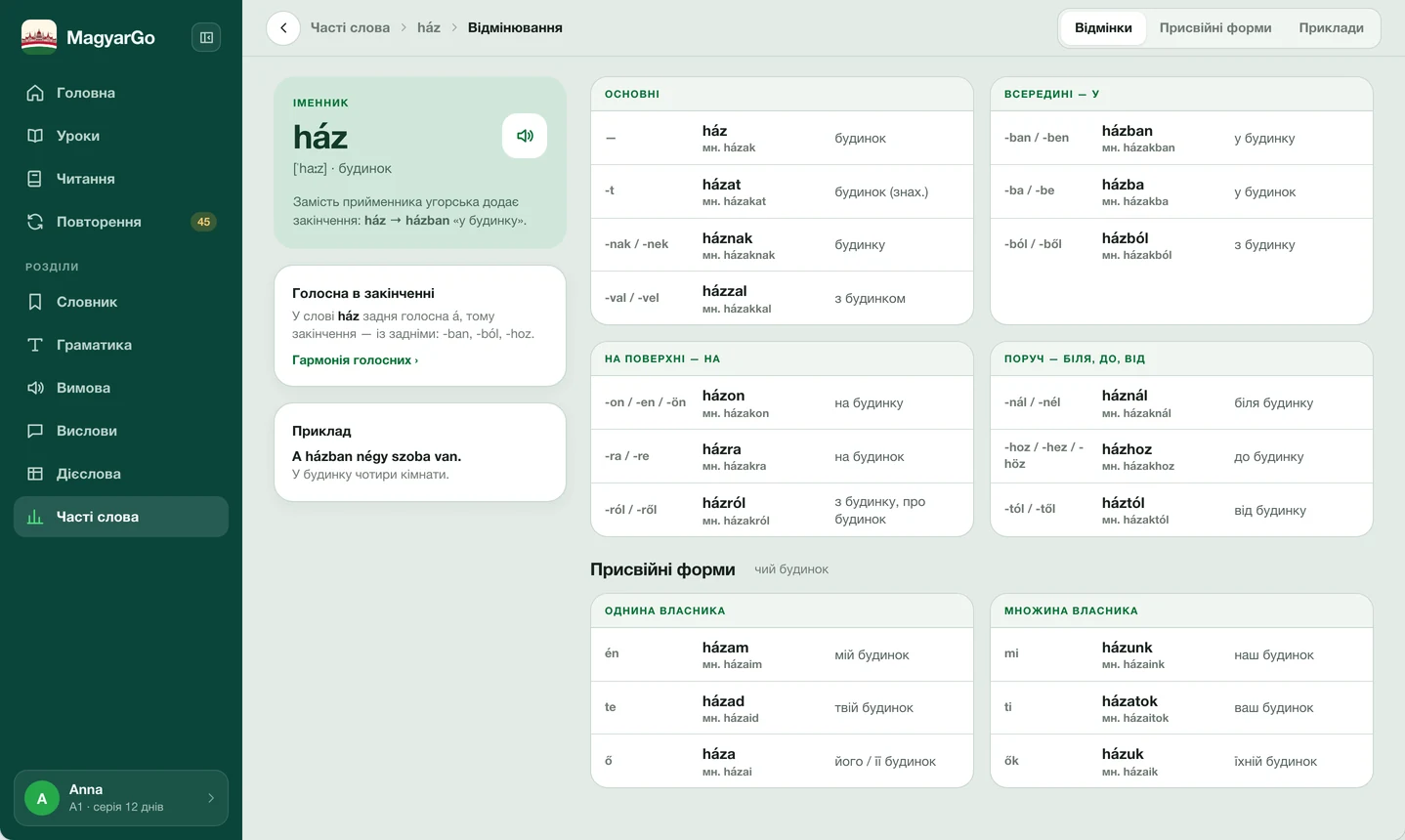
Every form of a word, as a table
For six thousand words: seventeen cases, the possessive forms “my, your…”, personal forms and comparison.
- Opens straight from a word card — in a lesson, a book or the dictionary.
- Select a row of the table to see an example with that form.
- Next to the table there is a note on why the ending is what it is.
- Cases
- My, your…
- Personal forms
- Comparison

The words you saved yourself
There is a bookmark everywhere: in lessons, books, expressions and the list of most frequent words. Everything you save is gathered in one place.
- View them as a list or as cards, and search your own words.
- The same eleven drills as in the lessons, only on your words.
- When there are many words, you choose which ones to practise today.
- bookmark
- list and cards
- search
- 11 drills
A habit you can see
A small daily goal, a streak and honest statistics — so you keep going.
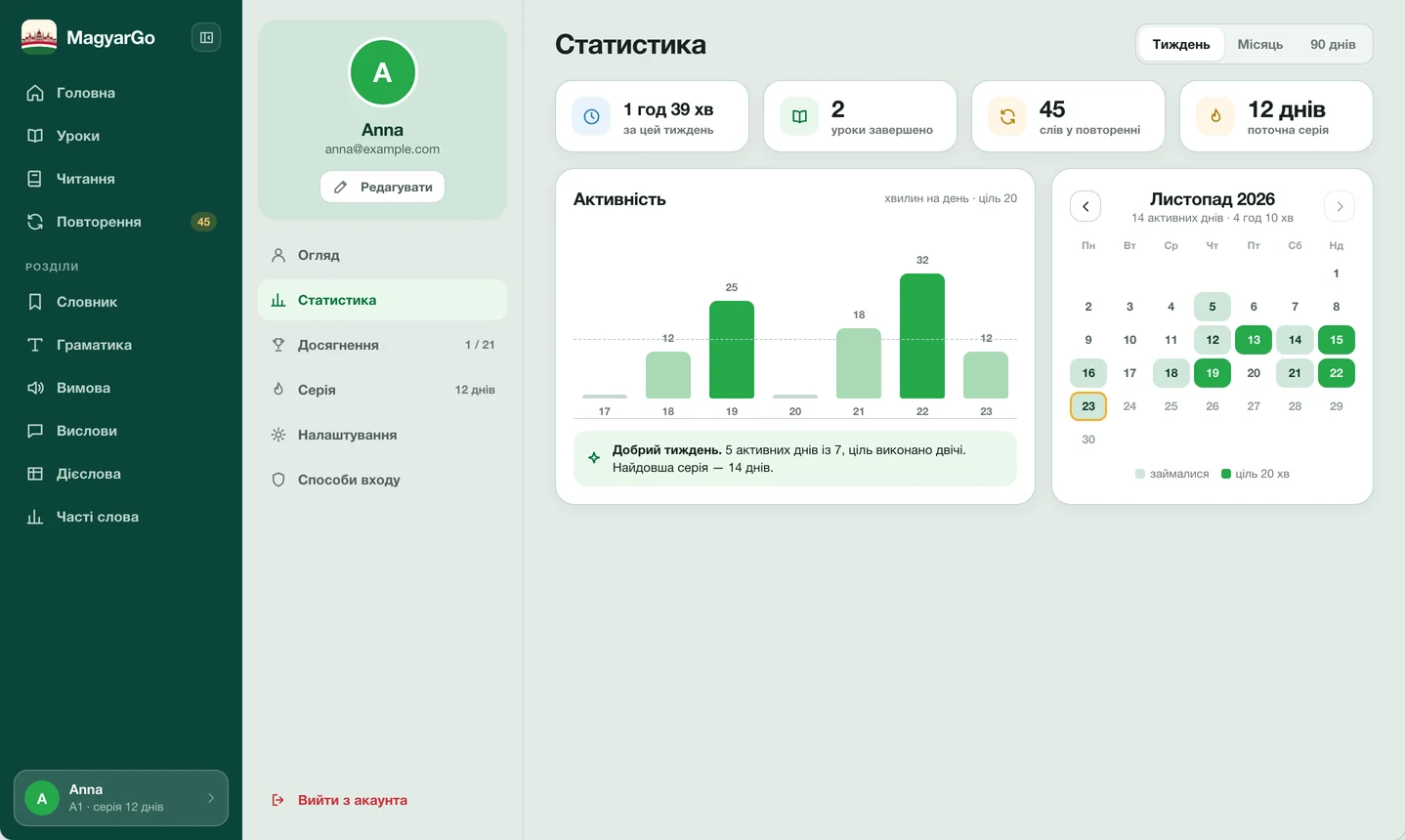
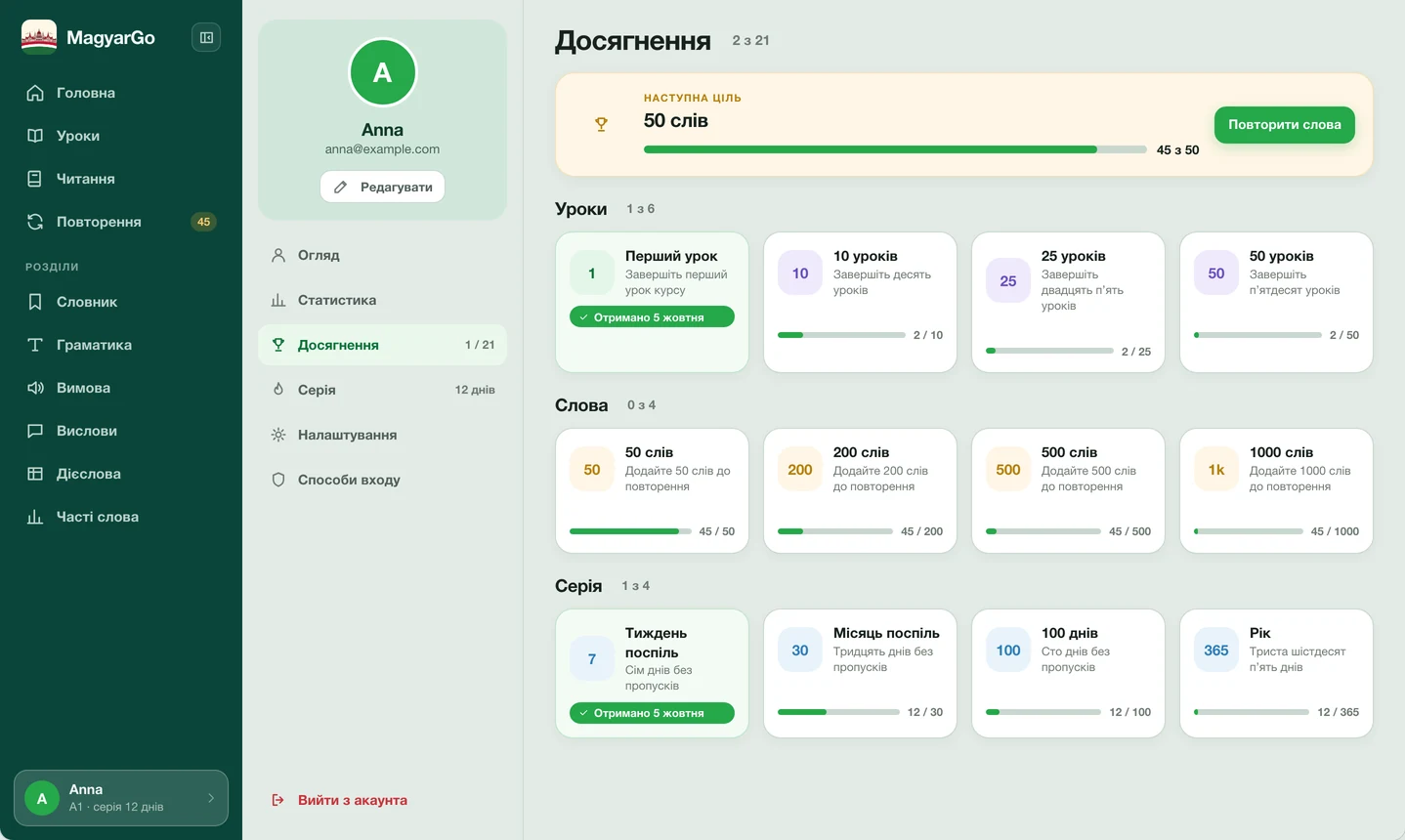
A daily goal, a streak and honest statistics
You choose how many minutes a day. MagyarGo counts the time and shows your streak and what is already done.
- A daily goal of your choice: 5, 10, 20 or 30 minutes.
- A streak with a calendar: days in a row, your longest streak and the days the goal was met.
- Statistics for a week, a month and 90 days: time, lessons completed, words in review.
- 21 achievements — for lessons, levels, the streak, words and reviews.
- “Word of the day” on the home screen: from one to ten new words a day.
- 5 min
- 10 min
- 20 min
- 30 min
Small things that make studying more pleasant
Start today, right in your browser
The whole course is open right now: 200 lessons, 75 books and all the guides. Signing up takes a minute.
The mobile app is coming soon to the App Store and Google Play. Read more